
HISTORY OF GSM
The foundation of the book "Graveyard of Good Intentions: Why Governments Launch Technology Strategies That Cannot Win" is a unique data set. Two UK government initiatives both having an ambition for UK global leadership, both in the same field of technology, both involving the same institutions, and both of a size and complexity to require many years to implement. What is priceless from a research point of view is that they had diametrically opposite outcomes - one leadership ambition was hugely successful and the other a dismal failure.
This allowed a large number of factors to be held constant leaving a high probability that the very different outcomes resulted from the policy differences. Critical to the integrity of the research is for those "policies" to be accurately identified from a reliable source. That was relatively straight forward for 5G as everyone involved is still around. But the GSM initiative took place forty years ago. Fortunately, I had made a first hand contemporary record. I was the senior DTI Official in all the rooms where the UK and EU policy decisions were decided. The account was written up and circulated within the DTI. I was prevented from publishing it under the Official Secrets Act. It was not until 2012 that I got official clearance from the head of the Civil Service to publish it with some minor deletions around the story of the GSM encryption algorithm. It was published on a web site my son Phillip created for me called http://www.gsmhistory.com/
There you will find the original account called "The Political History of GSM. It is a story of its time - the battles fought, the personalities involved and some deeds fair (on our side) and foul (on the side of the opposition) - which is why its publication was banned at the time. But in 2012 it was widely read by GSM colleagues across Europe. It was even quoted from in a leading Norwegian newspaper in a local dispute on who had invented SMS. Thus the account has been widely socialized both within the DTI, Whitehall and the rest of Europe.
It is from this original "historical account" that the policy decisions were identified and turned from an "historical" account into a "policy" account and to be found in Chapter 1 of the book "Graveyard of Good Intentions". This involved filtering out all the things specific to the time and not relevant today. For example, the small crisis that arose when it was discovered that GSM time pulse signals broke into hearing aids as audible noise.
Then all the GSM technology wrappers were stripped off. This was achieved by working back from the particular solution to identify the problem being addressed. From there work back to identify the generic policy in play. As an example, all the European mobile operators (except in the UK and Sweden) were monopolies and poorly performing. A GSM policy was to reserve spectrum for a second competitive GSM operator. That was the decision. The problem being addressed was poorly performing monopolies. The generic policy was intensifying infrastructure competition.
Competition is very useful in driving down prices for consumers but we still wanted the mobile operator competitors to co-operate with each other over common technical standards, implementing roaming and long term research. The GSM Memorandum of Understanding sets down this delineation between cooperation in "baking the cake" and competing over "who gets the largest slice". Track through this decision tree and it emerges in our Golden Rule 5:
RULE 5: Build Markets Together. Compete for Share.
Facilitate cooperation on everything needed to create the market, including research, standards, infrastructure de-risking - then let normal competition rules prevail and determine market shares, with competitor intensity matched to investment scale.
With this background now recorded here - there is full traceability from the the original contemporary record of the GSM initiative to the Ten Golden Rules.
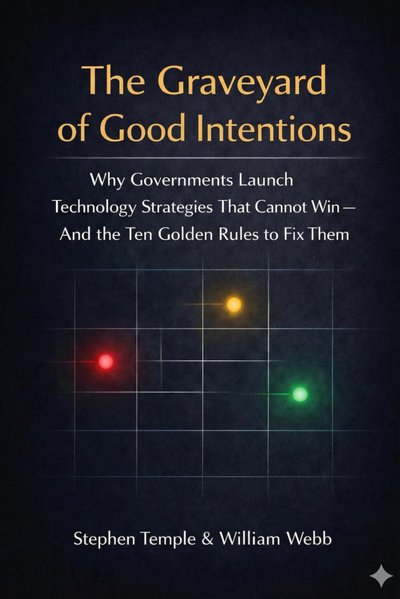
Why Governments launch technology strategies that cannot win - and the Ten Golden Rules to fix them.
All content here (c) copyright of Stephen Temple